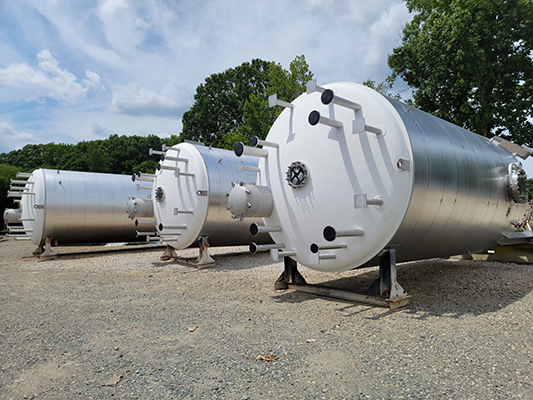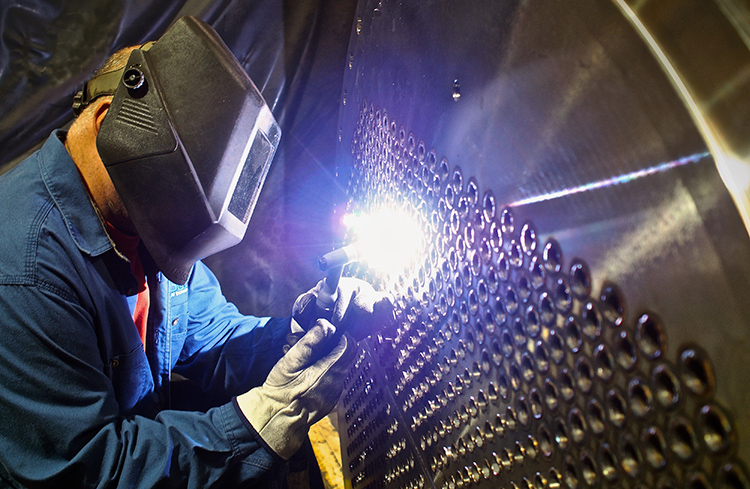

Data center cooling failures are measured in seconds. Custom-fabricated Thermal Energy Storage tanks give mission-critical facilities the thermal capacity to bridge power transitions, cut demand charges, and keep servers running, regardless of what the grid does.
Why Cooling Reliability Is a Business Continuity Issue
Data centers support some of the most operationally sensitive infrastructure in the modern economy, cloud services, financial transaction processing, AI compute, and enterprise IT systems that cannot tolerate interruption. Servers and networking hardware generate substantial heat continuously, and the cooling systems that manage that heat must do so without pause.
The failure modes are well understood: grid power outages, mechanical breakdowns in chiller or pump equipment, natural disasters disrupting utility supply, and operational errors that compromise cooling capacity. Any of these can create conditions where server hardware begins accumulating thermal stress within seconds, with consequences that scale rapidly from performance degradation to hardware damage to full service outage.
Traditional resilience strategies rely on redundant chillers, backup generators, and UPS systems. But there is a gap in most architectures that is only recently receiving serious engineering attention: the thermal bridge between the moment primary cooling fails and the moment backup capacity is fully operational.
"In a high-density server environment operating at 20+ kW per rack, server inlet temperatures can rise measurably in under a minute of lost cooling airflow. The margin between operational and critical is not hours, it is seconds."
— Bendel Tank & Heat Exchanger Engineering Team
What Is Thermal Energy Storage: How Does It Work?
A Thermal Energy Storage tank is a large-volume, precision-insulated vessel that stores thermal energy, in the form of chilled water, for deployment on demand. In a data center context, the tank is charged during off-peak hours by the facility's chiller plant, storing cold water at temperatures typically between 39°F and 44°F. During peak demand periods, power transitions, or primary system failures, that stored chilled water is circulated through the cooling loop to absorb server heat without requiring active chiller operation.
Types of TES Systems Used in Data Centers
-
Stratified chilled water tanks: Stratified chilled water tanks, the most common configuration for large data centers. Cold water settles at the bottom; warm return water rises to the top. A precision diffuser system maintains the thermocline between them. Storage capacity is a function of tank volume and the usable temperature differential between charge and discharge conditions. Cold, denser water naturally settles below warm return water, and the engineering challenge is preserving that thermal boundary (the thermocline) under real-world flow conditions.
-
Ice storage tanks: Ice storage tanks, use the latent heat of fusion to store a significantly higher energy density per unit volume than chilled water. Variants include external melt ice-on-coil, internal melt ice-on-coil, and encapsulated ice systems.
- Multi-tank systems: Multi-tank systems, combine chilled water and ice storage in configurations that provide greater flexibility, redundancy, and capacity for large-scale or phased installations.
For most large data center applications, stratified chilled water TES tanks are the preferred configuration, they integrate naturally with existing chilled water infrastructure, have no moving parts within the vessel, and can be fabricated to virtually any scale. This is the configuration Bendel Tank specializes in engineering and fabricating.
The Two Value Streams That Define TES ROI
Value Stream 1: Demand Charge Reduction
Utility demand charges calculated on peak power draw during a billing interval, can represent 30 to 70 percent of a commercial electricity bill. For data centers, peak IT loads tend to align with peak utility demand windows in the mid-afternoon, making demand charges structurally difficult to reduce through operational means alone.
TES changes that arithmetic. By charging the tank overnight at off-peak rates and discharging stored cold water during peak demand windows, a TES system directly reduces the chiller load that appears in those critical billing intervals.
|
30–70% Of commercial electricity bills attributed to demand charges |
$72K–$120K Potential annual savings for a 1,000-ton chiller plant shifting 40% of load |
10–45 sec Generator transfer window TES bridges during power transitions |
Value Stream 2: Cooling Continuity During Power Transitions
When utility power is interrupted, there is an elapsed window, typically 10 to 45 seconds, during which active chiller capacity is unavailable. In high-density environments operating at 20+ kW per rack, this window is operationally significant. A TES tank eliminates this exposure: stored chilled water circulates from the instant the grid drops out to the moment generators are fully online.
For facilities with uptime SLA commitments, where downtime costs can reach hundreds of thousands of dollars per hour, this cooling continuity value frequently exceeds demand charge savings in total economic impact.
Five Engineering Decisions That Determine TES Performance
TES tanks are deceptively simple in concept and highly sensitive to engineering decisions in practice. Getting these right is the difference between a system that delivers its rated ton-hours across its operational life and one that underperforms from day one.
1. Tank Aspect Ratio
The ratio of tank height to diameter directly governs thermocline stability. A taller, narrower tank produces a smaller thermocline cross-section, more resistant to turbulence and mixing under high flow rates. A short, wide tank at the same volume creates a larger, more vulnerable thermocline boundary. Bendel engineers the optimal aspect ratio within the actual site geometry constraints your mechanical room provides.
2. Diffuser Design and Inlet Froude Number
The diffuser distributes incoming flow with low velocity and minimal turbulence, preserving the thermocline. The key parameter is the inlet Froude number, a dimensionless ratio of inertial to buoyancy forces. Effective stratification requires a Froude number below approximately 0.5. This is derived from actual volumetric flow rate, tank diameter, and temperature differential. A catalog-standard diffuser cannot reliably achieve this target under site-specific conditions.
3. Insulation System and Vapor Barrier Integrity
A TES tank operating at 39–44°F in a warm mechanical room experiences continuous thermal load from the surrounding environment. Without properly specified insulation, standing heat gain erodes stored cold water temperature during hold periods. Vapor barrier design is particularly critical in humid climates, including the southeastern and mid-Atlantic US where data center construction is concentrated.
4. Nozzle Placement and System Integration
Cold supply nozzles at the lower tank section and warm return nozzles at the upper section define the operating zone of the thermocline. Nozzle placement also affects field installation complexity. Bendel customizes nozzle locations to match project-specific pipe routing, simplifying field labor and eliminating hydraulic shortcuts that would compromise stratification performance.
5. Sizing in Ton-Hours, Not Just Gallons
Tank volume in gallons is an incomplete specification. The useful cooling capacity of a TES tank is measured in ton-hours, the product of volume, specific heat capacity of water, and usable temperature differential. Two 200,000-gallon tanks specified at different temperature differentials can differ by 40%+ in actual available ton-hours. Bendel performs this calculation from your actual system parameters, not from a round-number catalog estimate.
Why Bendel: What to Look for in a TES Tank Fabricator
As TES adoption accelerates, the number of suppliers claiming TES fabrication capability will grow alongside the market. Here is how to distinguish credible engineering partners from opportunistic catalog extensions:
-
Engineering-first engagement: Begin with thermal sizing calculations and site-specific design parameters, not a product page.
- Complete ASME documentation: Provide ASME data reports, MTRs, hydrostatic test records, and weld documentation for AHJ review and owner records.
- Custom geometry capability: Engineer to your available footprint, diameter, height, orientation, and nozzle configuration derived from your site constraints.
- Diffuser engineering from your flow data: Derive diffuser geometry from your actual chilled water loop parameters, with a documented Froude number target.
- Climate-matched insulation: Specify insulation matched to operating temperature, ambient conditions, climate zone, and hold time requirements.
- Schedule reliability: Maintain shop capacity and project management discipline that data center construction schedules demand.
"Custom fabrication isn't a premium option for complicated projects. For data center TES applications, it's often the only option that actually works."
— Bendel Tank & Heat Exchanger
TES and the Green Data Center Mandate
Cooling can represent 30 to 40 percent of a data center's total power consumption. Thermal Energy Storage doesn't eliminate that energy use, but it changes when and how efficiently it is consumed, with meaningful sustainability implications:
-
Shifting chiller operation to cooler overnight conditions improves chiller COP, reducing electrical energy required per ton of cooling produced
-
Off-peak operation enables greater utilization of renewable generation, supporting renewable PPA utilization and carbon accounting
-
Reduced coincident peak demand improves PUE metrics that appear in most ESG reporting frameworks for data centers
-
For LEED certification, TES contributes to energy optimization credits across multiple point categories
- For facilities under sustainability-linked financing or investor ESG scrutiny, TES simultaneously improves the economic and environmental operating profile
Bendel TES Tank Capability at a Glance
Every specification below is a starting point, not a constraint. Bendel's engineering team derives tank parameters from your actual project requirements, not from a catalog page.
|
SPECIFICATION |
BENDEL CAPABILITY |
|
Construction Code |
ASME Section VIII, Div. 1; custom code combinations available |
|
Capacity Range |
Custom-engineered, from hundreds to tens of thousands of ton-hours |
|
Materials |
Carbon steel, stainless steel; coatings and linings per service requirements |
|
Orientation |
Vertical or horizontal; aspect ratio optimized per stratification requirements |
|
Diffuser Design |
Application-specific; inlet Froude number target ≤0.5 for stable stratification |
|
Operating Temp |
Engineered for chilled water service, typically 39–44°F supply |
|
Insulation System |
Polyurethane foam, fiberglass, or composite; vapor barrier matched to climate zone |
|
Nozzle Configuration |
Custom placement, quantity, and orientation coordinated with MEP pipe routing |
|
Documentation |
ASME data reports, MTRs, hydrostatic test records, weld records for AHJ review |
|
Sizing Methodology |
Ton-hours based on peak load, discharge duration, temperature differential, and stratification efficiency |
TES Tanks for Data Centers: Frequently Asked Questions
From how TES tanks work to what makes a fabricator credible, the questions facility managers and MEP engineers ask most often, answered by Bendel's engineering team.
Q. What exactly is a TES tank, and how does it function in a data center cooling system?
A Thermal Energy Storage tank is a large, insulated vessel that stores chilled water produced by your chiller plant during off-peak hours. During peak demand periods, power transitions, or chiller failures, that stored cold water is circulated through your cooling loop to absorb server heat, without requiring active chiller operation. Think of it as a thermal battery for your chilled water system: charge it when electricity is cheap, discharge it when you need it most. In a data center application, TES serves two simultaneous functions: reducing utility demand charges tied to peak chiller operation, and bridging the cooling gap during generator transfer events.
Q. How much can a TES system actually reduce our electricity costs?
The savings are project-specific and depend on chiller plant size, local utility rate structure, and the percentage of peak cooling load you shift to TES discharge. As a reference point: for a facility with a 1,000-ton chiller plant shifting 40% of daytime cooling to off-peak discharge, peak demand reduction can reach 400 kW or more. At commercial demand charge rates of $15–25/kW/month, that represents $72,000–$120,000 in annual demand charge savings from a single infrastructure investment. Demand charges can represent 30–70% of a commercial electricity bill, making the addressable savings pool substantial. Bendel can run the preliminary sizing and economics analysis during an engineering consultation.
Q. How does a TES tank protect the facility during a power outage or generator transfer?
When grid power is interrupted, generator systems require time to start, reach operating speed, and complete the automatic transfer sequence. That elapsed window, typically 10 to 45 seconds, is a period where active chiller capacity is unavailable. In high-density server environments, this is not a trivial gap. Server inlet temperatures respond quickly to lost cooling airflow, and hardware operating at 20+ kW per rack is sensitive to even brief thermal excursions. A properly sized TES tank maintains chilled water flow through the cooling loop from the instant the grid drops out to the moment generators are fully online.
Q. What is the thermocline, and why does it matter for TES tank performance?
The thermocline is the thermal boundary layer between cold, dense water at the bottom of the TES tank and warm return water at the top. The sharper and more stable the thermocline, the more of the tank's total volume functions as usable cold storage. If diffuser design is poorly matched to actual flow conditions, the thermocline degrades, and effective storage volume shrinks, sometimes by 20–40%. Bendel engineers diffuser geometry from your actual volumetric flow rates, targeting an inlet Froude number below 0.5, the threshold for stable stratification, rather than applying a generic catalog diffuser design.
Q. Why does custom fabrication matter— can't we just use a catalog product?
A catalog tank is designed around a generic set of flow assumptions. Under those exact assumptions, it may perform adequately. Under your actual flow rates, temperature differentials, and mechanical room constraints, it will almost never deliver optimal performance. Site constraints, ceiling height, floor footprint, pipe routing, often make a standard catalog configuration physically impossible without compromise. Bendel's approach is to start with your flow data and site parameters, then engineer the tank geometry, diffuser design, nozzle placement, and insulation system around those specific requirements.
Q. What are the main implementation challenges, and how does Bendel address them?
The most common challenges fall into five areas: initial capital cost (addressed by long-term ROI analysis Bendel supports with accurate sizing documentation); space requirements (addressed by custom geometry that fits your available envelope); integration complexity (addressed by MEP team coordination from early design through fabrication); insulation and vapor barrier performance (addressed by climate-matched specifications); and thermocline degradation, the most technically consequential challenge, addressed by diffuser engineering methodology derived from actual project flow parameters.
Q. Does TES contribute to LEED certification or ESG sustainability goals?
Yes, across multiple dimensions. By shifting chiller operation to cooler overnight ambient conditions, TES improves chiller COP and reduces total electrical energy consumed per ton of cooling produced. Off-peak operation aligns with renewable generation profiles, supporting renewable PPA utilization and carbon accounting. Reduced coincident peak demand directly improves PUE metrics that appear in most ESG reporting frameworks. For facilities under sustainability-linked financing or investor ESG scrutiny, TES is one of the few infrastructure investments that simultaneously improves economic and environmental operating profiles.
Q. How do I start the process of specifying a TES tank with Bendel?
The process begins with a technical consultation. Bendel's engineering team can assist with your facility's thermal load profile (peak cooling load in tons, discharge duration requirements), design parameters (supply and return temperatures, flow rates), site contraints (available floor footprint, ceiling heigh, pipe routing). To learn more about your operational objectives and project needs.
Ready to Run the Numbers on TES for Your Facility?
Bendel Tank engineers are available for a no-obligation technical consultation to discuss your thermal load profile, site contraints, and operational objectives.
.